Why Are Regional Parties Declining in India? Is the Idea of Federalism Being Weakened?
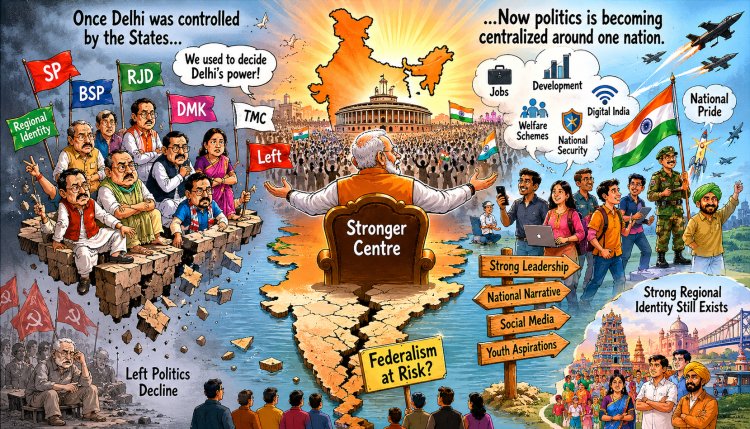
India’s political landscape is undergoing a major transformation as regional parties that once dominated coalition politics are steadily weakening. Since 2014, national politics has become increasingly centralized around strong leadership, national security, welfare delivery, and digital campaigning. Parties built on caste equations, family control, and regional identity are struggling to adapt to a younger electorate focused on jobs, development, nationalism, and governance. Regional parties also face internal problems such as dynastic politics, weak organizational structures, corruption allegations, and failure to modernize their political strategies. Meanwhile, the BJP has successfully built a nationwide narrative that often overshadows state-level issues. Social media and centralized election campaigns have further strengthened national politics over regional influence. The decline of Left parties reflects a broader ideological shift in India. Once dominant in states like Wes
Is Indian Politics Moving Toward a “One Nation, One Party” Model?
Read In Hindi https://politicsinsightindia.com/new/bharat-mein-kshetriya-dalon-ki-kamzor-hoti-rajnitik-shakti-left-ka-patan
A major transformation is quietly unfolding in Indian politics. This change is not just about electoral numbers; it concerns the very structure of Indian democracy. Regional parties that once controlled the balance of power in New Delhi are now struggling even within their own states. Socialist politics is weakening, Bahujan politics is fragmenting, Dravidian politics is becoming more limited, and the Left is nearing political irrelevance.
In the 1990s, India had a political system where the Prime Minister sat in Delhi, but power was determined in Patna, Chennai, Lucknow, Kolkata, and Hyderabad. Today, the situation has reversed. National politics has become so centralized that the voices of regional parties are gradually disappearing from the national discourse.
The biggest question is:
Is India returning to an era of single-party dominance?
The Golden Era of Regional Parties: When States Dominated Delhi
After 1989, Indian politics entered the coalition era. The dominance of Congress had weakened, while the BJP was still emerging. Regional parties filled this vacuum and gained tremendous influence.
In Uttar Pradesh, Mandal politics gave rise to the Samajwadi Party and Bahujan Samaj Party. In Bihar, Lalu Prasad Yadav became the symbol of social justice politics. In Tamil Nadu, Dravidian parties consistently challenged national parties. In West Bengal, the Left seemed unbeatable.
At that time, the power equation in Delhi looked something like this:
-
Governments were difficult without Mulayam Singh Yadav
-
Mayawati’s support carried enormous importance
-
Karunanidhi and Jayalalithaa could bring down central governments
-
Mamata Banerjee influenced national politics through the Railway Ministry
-
Left parties could shape even economic policies
Between 1996 and 2014, almost no government could survive without regional parties.
But after 2014, Indian politics began to change direction.
What Changed After 2014?
2014 was not just a transfer of power; it marked the beginning of the centralization of Indian politics.
The Bharatiya Janata Party created an electoral model in which:
-
Elections became centered around the Prime Minister
-
National security became a key issue
-
Welfare schemes were directly associated with the central government
-
National leadership became more influential than regional leadership
-
Social media overshadowed regional narratives
Earlier, voters elected Members of Parliament. Now, many voters think in terms of choosing a Prime Minister.
This marked the beginning of the real challenge for regional parties.
https://politicsinsightindia.com/new/bharat-ki-videsh-niti-bahudhruviya-vishva-vyavastha-sankat
The Biggest Weakness of Regional Parties: Dynastic Politics
Almost every major regional party became family-centric.
Examples include:
-
Samajwadi Party — the Yadav family
-
Rashtriya Janata Dal — the Lalu family
-
Shiv Sena — the Thackeray family
-
DMK — the Karunanidhi family
-
NCP — the Pawar family
-
Akali Dal — the Badal family
Initially, this model worked because the founding leaders had charismatic appeal. But the second and third generations could not build the same emotional connection with the masses.
Young voters increasingly reject dynastic politics. They are more attracted to opportunities, development, and national identity politics.
Why Is Caste Politics Weakening?
The 1990s were defined by Mandal vs. Kamandal politics, where caste was the most powerful political tool.
But after 2020, the priorities of the younger generation changed:
-
Jobs
-
Welfare benefits
-
Digital opportunities
-
Nationalism
-
Strong leadership
-
Social security
Winning elections solely through caste arithmetic has become more difficult.
For example, in Uttar Pradesh, the Samajwadi Party long depended on the Yadav-Muslim equation. But the BJP built a larger coalition by mobilizing non-Yadav OBCs and non-Jatav Dalits.
A similar strategy emerged in Bihar as well.
https://politicsinsightindia.com/new/dar-ke-bawajood-likhna-zaroori-hai
BJP’s Greatest Strength: The “National Narrative”
Regional parties speak about their states.
The BJP presents a story about the entire nation.
This difference is crucial.
When elections revolve around issues like:
-
Pakistan
-
China
-
Ram Mandir
-
National security
-
India’s global image
regional parties struggle because they lack a comparable national narrative.
Television channels and social media also amplify national issues more than regional ones, pushing local concerns into the background.
How Social Media Changed Politics
Politics was once decided on the ground. Now it is increasingly shaped on mobile screens.
The BJP invested much earlier than other parties in:
-
IT infrastructure
-
Data analytics
-
Digital campaigning
Regional parties fell behind because:
-
Their digital infrastructure was weak
-
Leadership failed to understand technological changes
-
Their reach among young voters remained limited
Today, political battles are fought more on WhatsApp and YouTube than in village gatherings.
Are Regional Parties Responsible for Their Own Decline?
To a large extent, yes.
1. Weak Organizational Structures
Many parties depended entirely on a single leader’s image.
Once the leader weakened, the party began to collapse.
2. Corruption Allegations
Several regional parties faced long-standing corruption charges, which alienated urban and young voters.
3. Failure to Understand New Politics
India is rapidly changing:
-
Digital economy
-
Startup culture
-
Expanding middle class
-
Nationalist sentiment
But many regional parties still appear trapped in the politics of the 1990s.
Why Have Left Parties Almost Disappeared?
This is perhaps the biggest ideological decline in Indian politics.
There was a time when:
-
The Left ruled West Bengal for 34 years
-
Tripura had a strong Left presence
-
Universities were dominated by Left ideology
-
Labor movements were led by Left parties
Today, Left politics has almost vanished from the national stage.
The Biggest Mistake of the Left: Failure to Adapt
The world changed, but the Indian Left continued speaking the language of the past.
While the world discussed:
-
AI
-
Startups
-
Digital capitalism
-
Globalization
the Indian Left largely remained focused on old-style protest politics.
Young people increasingly felt that Left parties only opposed policies but failed to offer practical solutions.
Why Did the Left Collapse in Bengal?
West Bengal was once the strongest fortress of Left politics. Yet it collapsed there first.
Reasons include:
1. Arrogance After Long Rule
After 34 years in power, the organization became disconnected from the public.
2. Anti-Industry Image
The Nandigram and Singur controversies created the perception that the Left opposed development.
3. Rise of Mamata Banerjee
Mamata Banerjee captured the rural, poor, and women voters who once supported the Left.
Today, Bengal’s politics is mainly a battle between the BJP and the Trinamool Congress. The Left has become nearly invisible.
Did the Weakening of Congress Also Harm Regional Parties?
Absolutely.
Earlier, Congress functioned as a broad umbrella party. As it weakened, regional parties became stronger.
But when Congress became too weak, the opposition fragmented. The BJP faced no united national challenge.
Regional parties remained confined to their own states.
Is India Returning to a Congress-Style Dominance?
Many political analysts believe the BJP has created a position similar to the one Congress once enjoyed.
The difference is:
-
Congress dominance resembled an umbrella coalition
-
BJP dominance is based on centralized leadership
Today, elections in many states are fought more in the name of national leadership than local issues.
Will Regional Politics Completely Disappear?
No.
A diverse country like India cannot function indefinitely under fully centralized politics.
Regional identity remains powerful in several states:
Tamil Nadu
Dravidian politics is still highly influential.
West Bengal
The Trinamool Congress remains a strong regional force.
Odisha
Although the BJD suffered setbacks, Naveen Patnaik’s influence lasted for decades.
Telangana
Regional identity politics still plays an important role.
What Will the Future of Indian Politics Look Like?
Indian politics now appears to be moving in three directions:
1. Centralized National Politics
Prime Minister-centered election campaigns are likely to continue.
2. Regional Resistance in States
Some states will continue resisting complete dominance by national parties.
3. Decline of Ideological Politics
Today, image and governance delivery matter more than ideology.
What Is the Biggest Danger?
If regional parties continue to weaken, Indian federalism could be affected.
Possible consequences include:
-
Weaker voice for states
-
Neglect of local issues
-
Decline in political diversity
-
Weakening of democratic balance
However, supporters of a strong central government argue that it leads to:
-
Faster decision-making
-
Policy stability
-
Stronger national unity
This remains one of the biggest debates in Indian politics today.
Can the Opposition Make a Comeback?
Yes, but not through old methods.
Regional parties and opposition forces will need to:
-
Understand the language of the younger generation
-
Embrace digital politics
-
Reduce dynastic control
-
Develop strong local leadership
-
Present clear models for development and employment
Simply opposing the BJP is no longer enough.
Conclusion: A New Era in Indian Politics
India is currently passing through a major political transition.
Regional parties have not disappeared, but their old power has weakened. The Left faces an ideological crisis. National politics is becoming increasingly centralized.
Yet the greatest strength of Indian democracy is its diversity. History shows that politics in India is never permanent. The party that best understands the aspirations of the new generation will shape the future.
The real question today is not merely who is winning elections.
The deeper question is: How multi-polar will Indian politics remain in the coming decade, and will the voices of the states be drowned out by the noise of Delhi?
Sudhir Taliyan
What's Your Reaction?