Chemsex: India's Emerging Public Health Crisis in the Digital Age
Chemsex is emerging as a new public health challenge in India. This in-depth analysis examines the NCB's warning, the role of synthetic drugs and digital platforms, associated mental and sexual health risks, and the policy measures needed to protect young people.
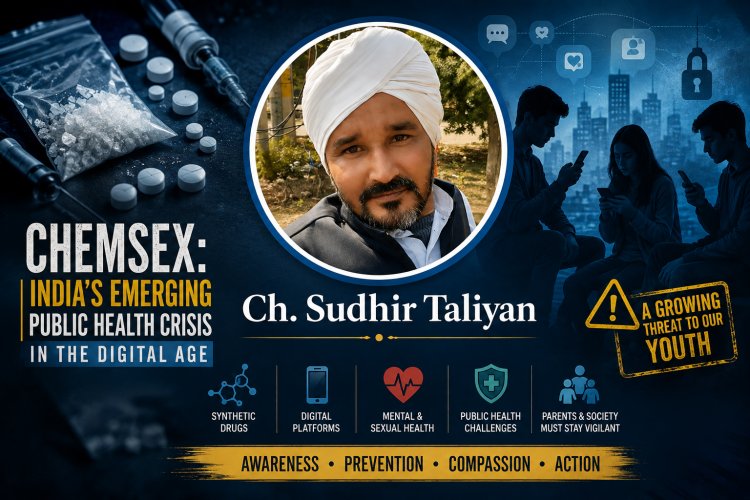
The Narcotics Control Bureau's latest warning highlights an emerging trend where synthetic drugs, digital platforms, and risky sexual behaviour converge—posing new challenges for public health, mental well-being, and law enforcement.
By - Ch. Sudhir Taliyan
Introduction
The Narcotics Control Bureau's (NCB) recent warning about the growing online visibility of "chemsex" among young people marks an important shift in India's approach to drug abuse. Traditionally, India's anti-drug discourse has focused on trafficking networks, cannabis, heroin, synthetic drugs at music festivals, and pharmaceutical misuse. The NCB's latest advisory, however, draws attention to an emerging phenomenon where psychoactive substances are intentionally used to facilitate or enhance sexual activity—a practice internationally known as chemsex.
While the agency has not claimed that chemsex has become widespread across India, it has observed increasing online discussions, particularly on social media and dating platforms, across multiple cities. This early warning deserves careful attention—not because it suggests a moral panic, but because international evidence indicates that chemsex can evolve into a complex public health issue involving addiction, mental illness, sexual health, and digital crime if left unaddressed.
The challenge for India is to respond before the problem becomes deeply entrenched.
Understanding Chemsex
Chemsex refers to the intentional consumption of psychoactive drugs immediately before or during sexual activity to prolong intimacy, increase stimulation, reduce inhibitions, or intensify pleasure.
Unlike recreational drug use, the defining characteristic of chemsex is that drug consumption is directly linked to sexual activity.
International medical literature identifies several drugs commonly associated with the practice:
-
Crystal Methamphetamine
-
Gamma-Hydroxybutyrate (GHB)
-
Gamma-Butyrolactone (GBL)
-
Mephedrone
-
Various synthetic stimulants and designer drugs
These substances stimulate the central nervous system or alter perception, producing temporary feelings of confidence, energy, reduced anxiety, and heightened sexual arousal. However, they also impair judgment, reduce awareness of personal safety, and increase the risk of dangerous behavior.
Why Has the NCB Issued a Warning Now?
According to the NCB, discussions around chemsex have increasingly appeared on social media platforms, encrypted messaging services, and dating applications across several Indian cities.
The agency has cautioned that digital platforms may occasionally be exploited not only for arranging private meetings but also for facilitating illegal drug procurement.
Importantly, the advisory does not state that dating applications themselves promote drug use. Rather, it highlights the possibility that some individuals misuse these platforms to connect with others involved in illicit drug activities.
The warning therefore reflects a preventive strategy: identifying emerging trends before they become widespread.
A Global Problem That India Cannot Ignore
Chemsex is not unique to India.
It first received significant attention in Europe during the early 2010s, particularly in cities such as London, Berlin, Amsterdam, and Barcelona. Public health authorities later documented similar patterns in Australia, North America, and parts of Southeast Asia.
International research consistently identifies several factors driving the practice:
-
Easy availability of synthetic drugs
-
Anonymous digital networking
-
Dating applications
-
Mental health problems
-
Loneliness and social isolation
-
Increasing nightlife and party culture
-
Curiosity and experimentation
Although these drivers differ across societies, globalization and digital connectivity mean that behavioral trends increasingly cross national boundaries.
India's rapidly growing internet penetration and widespread smartphone usage make early surveillance particularly important.
Why Is Chemsex So Dangerous?
The danger lies not merely in drug consumption but in the interaction between psychoactive substances and impaired decision-making during prolonged sexual activity.
1. Drug Overdose
Some drugs associated with chemsex, particularly GHB, have an extremely narrow margin between the intended dose and a potentially life-threatening overdose.
Excess consumption can lead to:
-
respiratory depression,
-
unconsciousness,
-
coma,
-
cardiac complications,
-
and, in severe cases, death.
Because these substances are often consumed in private settings, emergency medical assistance may be delayed.
2. Addiction
Crystal methamphetamine and mephedrone possess high addictive potential.
Repeated use can produce:
-
dependence,
-
withdrawal symptoms,
-
compulsive drug-seeking behavior,
-
deterioration in work or academic performance,
-
financial instability.
Long-term users frequently require structured addiction treatment rather than simple detoxification.
3. Mental Health Consequences
Numerous studies have linked prolonged stimulant use with serious psychiatric complications, including:
-
anxiety disorders,
-
depression,
-
panic attacks,
-
hallucinations,
-
paranoia,
-
psychosis,
-
suicidal thoughts in severe cases.
Drug-induced psychosis can sometimes resemble schizophrenia, making diagnosis and treatment particularly challenging.
4. Increased Risk of Infectious Diseases
One of the major public health concerns associated with chemsex is an increased likelihood of unsafe sexual practices.
Medical experts warn that this can elevate the risk of:
-
HIV
-
Hepatitis B
-
Hepatitis C
-
Syphilis
-
Gonorrhea
-
Chlamydia
The risk increases further when prolonged intoxication affects judgment or the ability to negotiate safer-sex practices.
Digital Platforms: Opportunity and Risk
Digital technology itself is not the problem.
Social media platforms and dating applications serve millions of legitimate users every day.
However, encrypted messaging, anonymous profiles, location-based matching, and private groups can also be exploited by individuals involved in illegal drug markets.
Globally, law enforcement agencies increasingly monitor online networks used for:
-
drug procurement,
-
coded advertisements,
-
arranging private gatherings,
-
recruiting new participants.
The NCB's advisory reflects these international enforcement trends rather than an allegation against any particular platform.
Why Adolescents and Young Adults Are Especially Vulnerable
Young adults are naturally more likely to experiment with new experiences.
Several factors increase vulnerability:
-
peer pressure,
-
curiosity,
-
fear of social exclusion,
-
online influence,
-
mental health challenges,
-
relationship stress,
-
lack of awareness regarding synthetic drugs.
Research consistently shows that adolescents' brains are still developing, particularly the regions responsible for impulse control and long-term decision-making.
https://politicsinsightindia.com/new/sarkar-maafi-jawabdehi-loktantra
This makes prevention through education significantly more effective than punishment after addiction develops.
Warning Signs Families Should Watch
The NCB advises parents and guardians to look for significant behavioral changes rather than relying on any single symptom.
Possible indicators include:
-
sudden withdrawal from family,
-
unexplained changes in friend groups,
-
declining academic or workplace performance,
-
frequent financial demands,
-
mood instability,
-
unusual sleep patterns,
-
bloodshot eyes,
-
enlarged pupils,
-
prolonged wakefulness,
-
unexplained drug-related paraphernalia.
These signs are not proof of drug use, as many can have other medical or psychological causes. However, persistent changes warrant sensitive conversation and, if necessary, professional evaluation.
Beyond Criminal Justice: A Public Health Perspective
Perhaps the most important aspect of the NCB advisory is its emphasis on support rather than stigma.
Instead of recommending punitive responses within families, the agency encourages:
-
open communication,
-
awareness,
-
timely intervention,
-
professional counseling,
-
addiction treatment,
-
community support.
This approach aligns with modern international public health strategies, which increasingly recognize substance dependence as a medical and psychological condition requiring evidence-based treatment rather than solely criminal punishment.
https://politicsinsightindia.com/new/digital-politics-troll-army-gundagardi-democracy-genz
Policy Challenges for India
India currently faces several structural gaps:
Limited Research
Reliable nationwide data on chemsex prevalence remain scarce.
Mental Health Infrastructure
Access to psychiatrists, psychologists, and addiction specialists remains uneven, particularly outside major cities.
Public Awareness
Many parents and teachers are unfamiliar with synthetic drugs and their behavioral indicators.
https://politicsinsightindia.com/new/gen-alpha-activism-up-school-children-protest-for-fans-water
Digital Surveillance
Balancing privacy with law-enforcement monitoring of online drug markets presents legal and ethical challenges.
Harm Reduction
India lacks comprehensive educational programmes specifically addressing the intersection of drug use and sexual health.
What Should Be Done?
A balanced national strategy should include:
Strengthening surveillance
Regular monitoring of emerging synthetic drug trends.
School and university education
Evidence-based drug education rather than fear-based messaging.
Mental health support
Improving access to counseling services for adolescents and young adults.
Parental awareness campaigns
Helping families recognize warning signs and communicate effectively.
Healthcare training
Equipping physicians and emergency departments to identify and manage chemsex-related complications.
Digital cooperation
Working with technology companies to detect illegal drug trafficking while respecting user privacy and due process
.
Avoiding Moral Panic
One important caution is necessary.
The NCB has highlighted an emerging trend, not a nationwide epidemic.
Public discussion should therefore avoid sensationalism.
Overstating the problem could stigmatize young people or unfairly portray all users of dating platforms as engaging in risky behavior.
At the same time, dismissing the warning would ignore valuable early signals from India's primary narcotics enforcement agency.
Balanced awareness is therefore essential.
Conclusion
The NCB's advisory represents more than a warning about drugs—it highlights the changing nature of substance abuse in the digital age. Chemsex sits at the intersection of narcotics, mental health, sexual health, technology, and youth culture, making it a multidimensional policy challenge.
India has an opportunity to act before the problem becomes deeply rooted. Success will depend not only on stronger law enforcement but also on public education, accessible mental health services, responsible digital governance, and compassionate family support.
Ultimately, preventing chemsex is not simply about controlling drugs. It is about protecting young people from a combination of addiction, exploitation, preventable illness, and long-term psychological harm through informed, evidence-based, and stigma-free interventions.
Get every story on your phone
Join our channel and never miss an update.
What's Your Reaction?