Iran’s Big Message From India: “Peace Needs Justice, Not More War”
Iranian Deputy Foreign Minister Kazem Gharibabadi delivered a strong message during his speech in India, stating that peace in the Strait of Hormuz is only possible by restoring pre-war regional stability. He claimed Iran has never attacked its neighbors and emphasized that Tehran follows international law despite ongoing tensions. Gharibabadi also rejected claims that BRICS is weakening and argued that resilience and strategy matter more than advanced military technology. His remarks have sparked global debate over Middle East tensions, energy security, and the rise of a new multipolar world order.
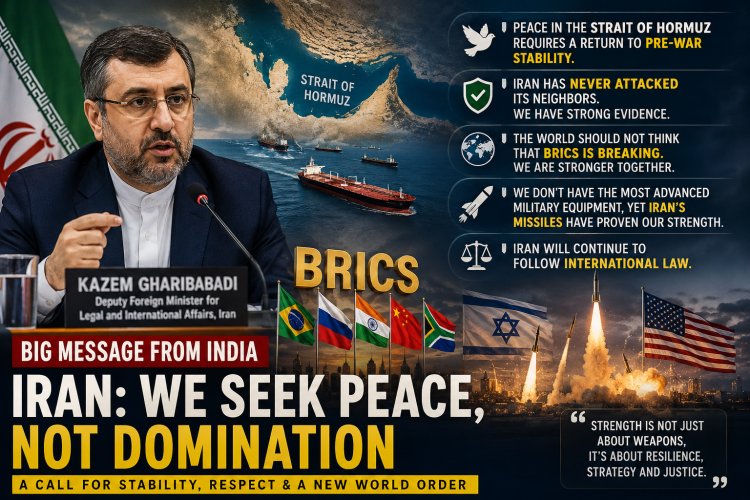
Iran’s Message From India: “Peace in the Strait of Hormuz Requires a Return to Pre-War Stability”
A powerful statement delivered in India by Kazem Gharibabadi has sparked fresh debate over the future of the Middle East, global energy security, and the emerging balance of world power.
Speaking at an international gathering, the Iranian Deputy Foreign Minister for Legal and International Affairs said that lasting peace in the Strait of Hormuz can only be achieved if the region returns to the conditions that existed before the escalation of conflict and military tensions. His remarks appeared to be aimed not only at regional rivals, but also at global powers deeply involved in Middle Eastern geopolitics.
Gharibabadi stated that Iran has never initiated attacks against its neighboring countries and claimed Tehran possesses strong evidence to support that position. He emphasized that Iran’s policies are based on regional stability, sovereignty, and resistance against external pressure.
The Strait of Hormuz remains one of the world’s most strategically important waterways, carrying a major share of global oil and energy shipments. Any instability in the region immediately affects international markets, fuel prices, and geopolitical calculations across Asia, Europe, and the United States. Because of this, Iran’s comments are being viewed as far more than a routine diplomatic statement.
In one of the most closely watched parts of his speech, the Iranian official warned against the perception that BRICS is weakening or fragmenting under global pressure. According to him, the rise of multipolar cooperation is continuing despite international tensions, and countries outside the traditional Western bloc are becoming increasingly influential in shaping the future world order.
He also made a striking observation regarding military capability. Gharibabadi admitted that Iran does not possess the most advanced military equipment compared to major global powers. However, he argued that recent conflicts demonstrated how strategic planning, missile technology, and national resilience can challenge even the strongest military alliances.
Without directly calling for confrontation, he suggested that military superiority alone does not guarantee political success. His comments are already being interpreted by analysts as a signal that Iran wants to project confidence despite sanctions, diplomatic isolation, and ongoing regional tensions.
At the same time, the Iranian diplomat stressed that Tehran intends to continue following international law and prefers diplomatic engagement over prolonged conflict. He presented Iran as a country seeking recognition of its security concerns rather than endless escalation.
Political observers believe the speech was carefully crafted for an international audience, especially at a time when the Middle East is experiencing rising uncertainty and shifting alliances. Delivering such remarks in India — a country maintaining relations with both Western nations and regional powers — added further strategic significance to the message.
The speech has quickly gained traction across social media platforms, with supporters calling it a bold assertion of sovereignty while critics see it as part of a larger geopolitical narrative aimed at countering Western influence in the region.
Whether this statement becomes a turning point in regional diplomacy or simply another chapter in the ongoing geopolitical struggle, one thing is clear: Iran is trying to position itself not as an isolated state, but as a central player in the debate over the future of global power, regional stability, and the emerging multipolar world.
What's Your Reaction?