U.S. Arms Shipments to Israel Raise Questions Over Rising Iran Tensions
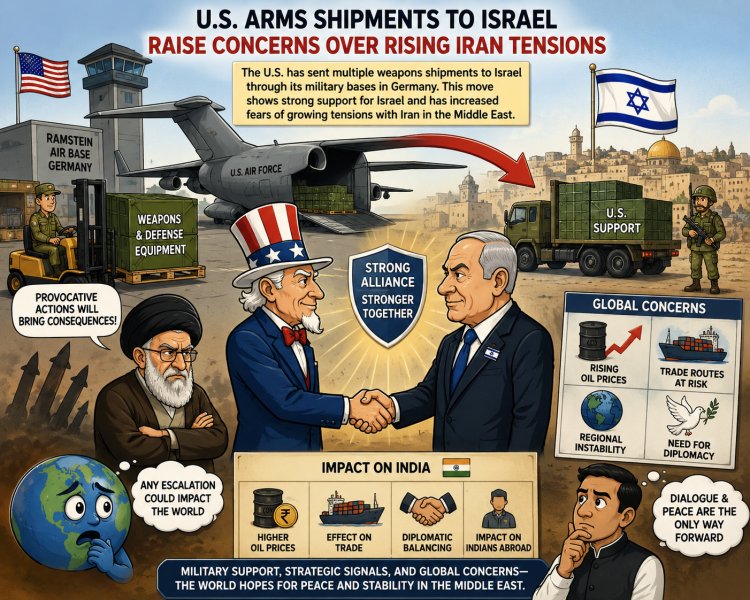
The United States has reportedly sent multiple weapons shipments to Israel through its military bases in Germany, raising concerns about growing tensions in the Middle East. Although there is no official confirmation of preparations for direct war with Iran, the military activity is being seen as a strong signal of U.S. support for Israel amid regional instability. Analysts believe the shipments are meant to strengthen deterrence as conflicts involving Iran-backed groups, Israel, and American interests continue across the region. The situation has also increased global concerns over oil prices, trade routes, and wider geopolitical risks. Countries like India are closely monitoring developments because any major escalation could impact energy security, diplomacy, and regional stability.
U.S. Arms Shipments to Israel Raise Questions Over Rising Iran Tensions
Fresh reports about American military cargo flights and weapons shipments moving from U.S. facilities in Germany to Israel have once again intensified global attention on the fragile security situation in the Middle East. The development comes at a time when relations between the United States, Israel, and Iran remain highly strained due to regional conflicts, proxy confrontations, and concerns surrounding Iran’s military activities.
While Washington has not officially described the recent shipments as preparation for direct military action against Iran, analysts believe the transfers signal that the United States is determined to maintain strong military support for Israel amid growing instability in the region.
Why Germany Matters in U.S. Military Operations
Germany hosts some of the most important American military bases outside the United States. Facilities such as Ramstein Air Base act as major logistics hubs for NATO operations and U.S. military deployments across Europe and the Middle East. Military equipment, defensive systems, ammunition, and emergency supplies are often transported through these bases before reaching allied countries.
Recent tracking reports from defense observers and aviation monitoring groups indicated increased cargo activity involving American military aircraft heading toward Israel. Although governments rarely disclose the exact contents of such shipments, experts believe they may include defensive interceptors, precision-guided equipment, artillery support systems, and air-defense components.
The shipments are being viewed in the broader context of ongoing security cooperation between Washington and Israel, which has remained one of America’s closest strategic partnerships for decades.
Is the U.S. Preparing for a Larger Conflict?
At present, there is no official confirmation that the United States is preparing for a direct war with Iran. However, the movement of military supplies often reflects concern over possible escalation scenarios.
Tensions between Iran and Israel have increased sharply over the past few years. Both countries have accused each other of cyberattacks, covert operations, and regional destabilization. Iran supports several armed groups across the Middle East, while Israel has repeatedly stated that it will not allow Iran to develop military nuclear capability.
The United States, meanwhile, continues to accuse Iran of threatening regional stability through its support for proxy militias in countries such as Lebanon, Iraq, Syria, and Yemen.
Security experts say Washington’s latest military support to Israel is likely aimed at deterrence — a strategy designed to discourage hostile actions by demonstrating readiness and alliance strength.
Rising Regional Instability
The Middle East remains one of the world’s most volatile regions. Any military movement involving the United States, Israel, or Iran immediately attracts global attention because even a limited confrontation could affect international trade, energy markets, and diplomatic relations.
Several recent developments have contributed to growing concerns:
-
Increased attacks involving regional proxy groups.
-
Ongoing maritime security incidents in strategic waterways.
-
Continued disagreements over Iran’s nuclear program.
-
Israeli concerns over missile and drone threats.
-
American military deployments in the Gulf region.
Because of these overlapping crises, even routine military shipments are now being interpreted through the lens of possible escalation.
Iran’s Likely Response
Iran has consistently criticized American military support for Israel. Iranian officials often argue that Western arms transfers contribute to instability in the region rather than peace.
However, Tehran is also aware that a direct military confrontation with either Israel or the United States would carry serious economic and strategic risks. Iran’s economy continues to face pressure from sanctions, inflation, and regional uncertainty.
For this reason, many analysts believe Iran may continue relying on diplomatic messaging and indirect regional influence rather than pursuing open confrontation.
At the same time, Iran is unlikely to remain silent. Experts expect strong political statements from Tehran warning against what it may describe as “provocative military actions” by Washington and Tel Aviv.
What the United States Wants
American officials have repeatedly stated that their primary goal is to prevent wider regional war while protecting allies and ensuring freedom of navigation in international waters.
The Biden administration earlier emphasized deterrence and crisis management in the Middle East, and even under evolving American political leadership, the broad strategic priorities remain similar:
-
Prevent regional escalation.
-
Protect Israel’s security.
-
Counter attacks on U.S. forces and allies.
-
Maintain stability in global energy routes.
-
Avoid a prolonged direct conflict.
Military assistance to Israel therefore serves both symbolic and practical purposes. Symbolically, it reassures an ally. Practically, it strengthens defensive preparedness in case tensions worsen unexpectedly.
Global Concerns Over Oil and Trade
One major reason why every Iran-related military development matters globally is energy security. The Middle East remains central to global oil supplies, and any threat to shipping routes in the Persian Gulf can influence crude oil prices worldwide.
If tensions between Iran and the United States were to rise significantly, markets could react sharply. Higher oil prices would affect transportation, inflation, and economic growth in many countries, including India.
Global investors also closely watch military developments because uncertainty in the Middle East often creates instability in financial markets.
Impact on India
India maintains important relations with all sides involved — the United States, Israel, and Iran. This balancing strategy is vital for India’s energy needs, regional diplomacy, and defense partnerships.
A major escalation would create several challenges for India:
1. Rising Oil Prices
India imports a large share of its energy needs. Any disruption in Gulf shipping routes could increase fuel costs and inflation domestically.
2. Pressure on Trade Routes
Indian trade depends heavily on Middle Eastern maritime routes. Regional instability could increase shipping costs and insurance risks.
3. Diplomatic Balancing
India has strong defense cooperation with Israel and strategic relations with the United States, while also maintaining historical ties with Iran. Escalation would complicate diplomatic positioning.
4. Impact on Indian Workers Abroad
Millions of Indians work across Gulf countries. A broader regional crisis could create economic and security concerns for expatriate communities.
For these reasons, India consistently supports dialogue, de-escalation, and diplomatic engagement in the region.
What Happens Next?
At the moment, the situation appears more connected to military preparedness and strategic signaling rather than immediate war plans. Defense analysts believe the United States wants to demonstrate commitment to Israel while discouraging further regional escalation.
Still, the Middle East remains unpredictable. Small incidents can quickly trigger wider tensions due to the involvement of multiple regional actors and global powers.
The coming weeks will likely depend on:
-
Iran’s diplomatic and military response.
-
Israeli security calculations.
-
American strategic messaging.
-
Developments involving regional proxy groups.
-
International diplomatic efforts to reduce tensions.
For now, the movement of U.S. military supplies through Germany to Israel has become another reminder of how fragile the regional security environment remains — and how closely the world is watching every signal coming from the Middle East.
Get every story on your phone
Join our channel and never miss an update.
What's Your Reaction?